
Searching Millard County Criminal Dockets
Utah Courts Xchange is the main remote channel. For a Millard County criminal docket, Utah Courts Xchange is the main public channel. It spans district and justice court cases. Remote use may cost money or require an account. Free terminals sit in the courthouse, and the Utah State Law Library offers access too. Older or missing records need another route. Send a specific record request to the clerk that holds it.
Pull the case number and court location straight off the notice. No notice? Search the defendant name as filed, narrow to the county, and guess the court level. Xchange itself warns that case and citation numbers repeat across Utah. Broad searches get capped. A tight Millard County criminal search beats a statewide name sweep every time.
- Choose District Court, Justice Court, or both only if jurisdiction is unknown.
- Enter the exact case number, or use the filed name with Millard County and a case type.
- Match the county, court location, filing date, role, and case number before opening history.
- Read charges, proceedings, settings, plea, disposition, and later entries together.
- Ask the proper clerk for a certified copy when formal proof is required.
Millard Criminal Search Fields
Xchange's search fields exist to stop false matches. The jurisdiction filter handles the split. Felonies and class A matters sit apart from most class B or C misdemeanors and infractions. Court scope then anchors the results to Millard County. Birth date can narrow things sharply, though you should never republish it. Citation location matters as well, because one citation number can point to more than one Utah place.
| Field | Best use | Check |
|---|---|---|
| Jurisdiction | District for felony or class A; Justice for most lower offenses | Do not mix court levels |
| Case number | Use the number on court papers | Pair with court location |
| Name | Use filed spelling and a wildcard only when needed | Confirm party role |
| Case type | Narrow with an official code | A type is not an outcome |
| Date range | Narrow filing, disposition, or judgment | Fields have distinct meanings |
Note: A blank result does not mean no case exists. The court could be wrong, entry could be delayed, coverage may not reach old files, or access may be restricted.
Inside a Millard Criminal Docket
A public Millard County criminal case history is rich. It can show the caption, court, case type, filing date, judge, attorneys, prosecution agency, charges, pleas, proceedings, settings, financial accounting, and links to public documents. The first two digits of a case number usually mark the filing year. Read the full number with its court, though. An online history is a chronology, nothing more. Not every report, exhibit, or private detail in the file appears there.
| Case Number | A court identifier such as 26XXXXXXXX; verify its location. |
|---|---|
| Charges | Offense description, level, attributes, and count sequence where public. |
| Proceedings | Arraignment, pretrial, motion, trial, sentencing, review, and continuance entries. |
| Plea and Disposition | Plea, judgment, result code, date, and later correction entries. |
| Accounting | Fine, fee, paid amount, and balance fields when exposed. |
Millard Criminal Court Routing
Felonies and class A misdemeanors from Millard County go to the Fourth Judicial District. Millard County Justice Court takes the rest. It handles most class B and C misdemeanors, infractions, and county traffic matters. Delta City and Fillmore City justice cases also have routes. They run through local payment and state court channels. When a charge is bound over, it moves from justice court to district court. Let the destination entry steer your next search.
The official payment court selection lays out the routes. The listed routes cover Millard County, Fillmore City, and Delta City.
That screen tells you the local court. It never replaces Xchange history or a clerk record request for payment status.
How a Criminal Case Moves
Every case starts with a filed charge or a citation. Arraignment covers the charge, rights, counsel, and plea. A not-guilty plea opens options. Pretrial settings, motions, a later plea, or trial can follow. The disposition records the court's result, and sentencing or further review may come after. One caution: a setting is only a scheduled event. It does not prove the event happened or that the case ended.
Docket flow: Charge Filed › Arraignment › Pretrial Settings › Plea or Trial › Disposition › Sentencing
- Bound over
- The matter moves to district court; follow the new number and location.
- Setting
- A scheduled event that may later be continued.
- Disposition
- The result of a charge or case, read with later entries.
- Vacated
- A prior entry was set aside; the history shows what followed.
Millard Criminal Plea Route
Some out-of-area defendants can enter a written guilty or no-contest plea through Millard County Justice Court. DUI and domestic-violence matters are excluded. Direct contact with the court is required. The route is not a general way around arraignment. It only works if the court accepts it for that case.
The county's Entry of Plea instructions describe the mail and email options. They set a 48-hour advance submission point.
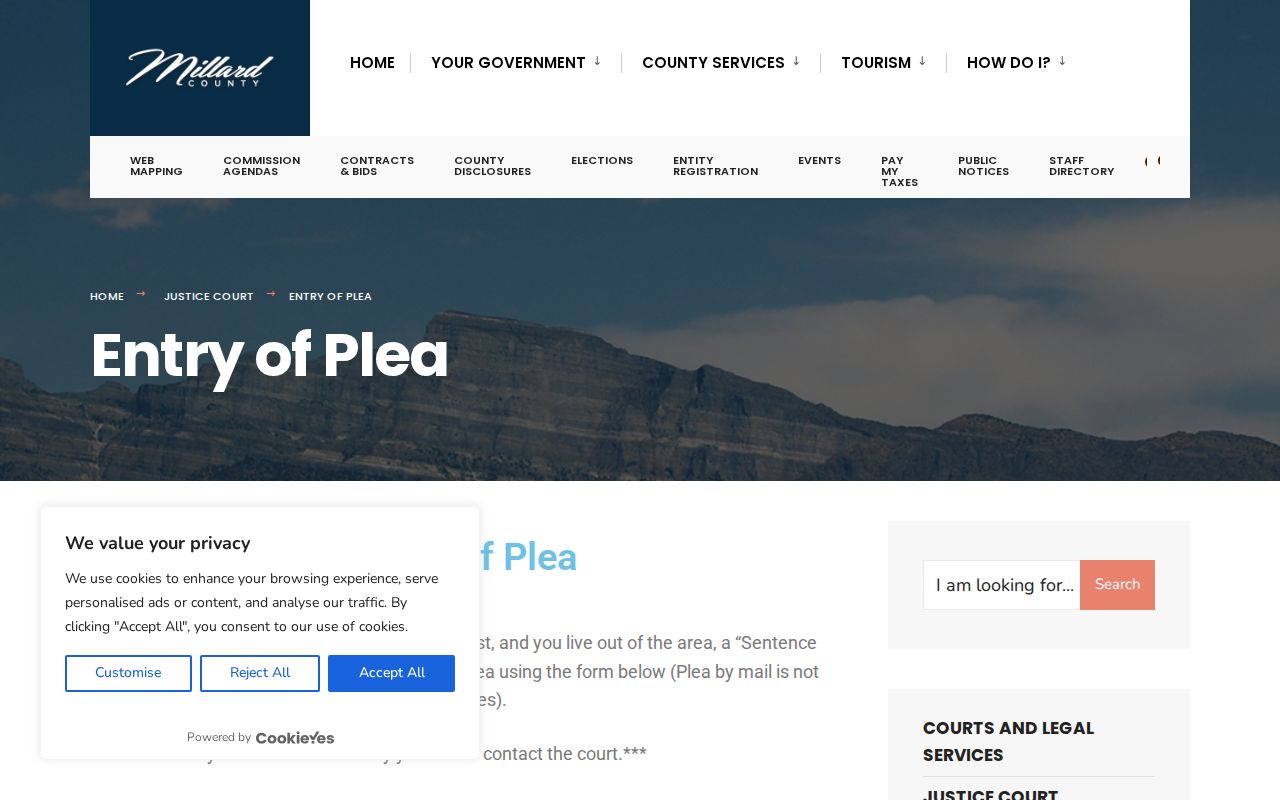
The county's plea page documents the local path in full. Still, the citation, the hearing notice, and current clerk direction control what you must do.
Courts That Hold Criminal Dockets
Marki Rowley is the district-level contact. She serves as Millard County Clerk and Fourth District Court clerk/manager. Justice court clerks keep the limited-jurisdiction dockets. Juvenile matters sit with Fourth District Juvenile Court. They are not ordinary public Xchange searches. Which office is right depends on offense level plus any transfer or appeal along the way.
Ask the district clerk for an order or older case. Include the county, court, case number, party, record type, and date range. For a justice matter, call the court printed on the citation. A written request can involve staff research, redaction, copying, or certification. When a calendar and a case history disagree, a phone call to the clerk settles it.
Millard Criminal Case Payments
The county's payment vendor takes a citation or court case number. But it only works for the right justice court. A failed lookup proves nothing about whether the criminal case exists. Citations can take days to post. Hand entry slows that further. A mistyped number or a case with nothing owed also returns no result.
The citation and case-number form shows how narrow those payment fields are.
Treat it as payment status only. For chronology and orders, trust Xchange proceedings and the clerk.
Millard Criminal Disposition Codes
Utah judgment records rely on terse codes. BO stands for bound over. CS is a criminal sentence. PA is a plea in abeyance, and XA or XP points to expungement work. Guilty entries split into G, GP, GB, and GJ. Dismissal itself comes in several forms. Read any code next to the charge, the event date, and what the court did afterward.
Money entries raise a separate question. FP can signal a fine was paid. Yet it cannot prove every condition of a sentence is finished. For unpaid balances tied to service, the local community-service page covers nonprofit verification and local credit.
A status code alone can never substitute for the judge's order and the full case history.
Sealed Dockets and Public Access
Utah rules presume that court records are open. Yet classification decides what a viewer actually sees. A Millard County criminal docket can stay public. One protected document or identifier can stay hidden. Expunged and sealed cases move through restricted paths, and juvenile matters face separate limits. Do not try name spelling tricks to rebuild an expunged case.
Key Rules:
UCJA Rule 4-202.02 classifies court records and identifies restricted groups.
UCJA Rule 4-202.03 sets public access and sealed-record limits.
UCJA Rule 4-202.04 governs specific written requests and entitlement.
MyCourtCase is free, but only for a party's own eligible case. It is not a name-search tool for the public. A certified court order also remains a different thing from an online history printout or a purchased document image.
Millard Criminal Case Transfers
How a Millard County criminal docket moves depends on the court and the charge level. An arraignment in justice court might lead to a not-guilty plea and pretrial. It might also follow an eligible plea path. Felony charges can be bound over to Fourth District Court. The district record then becomes the essential one. The old justice court number may stop showing the next hearing. Trial may go before a judge or a jury. Judgment, criminal sentence, review, and satisfaction entries can land at different points along the way.
No single status word settles everything. "Closed" may just describe court administration. It says nothing about a remaining fine, a filed appeal, or a later expungement of the public record. "Dismissed" also splits into several Utah code variants. Put the charge-level result beside the plea, the order date, the later entries, and the court location. That approach takes longer than trusting one label. But it keeps a Millard County criminal docket from being misread.
Millard Criminal Setting Patterns
Local pages sketch recurring hearing patterns. But a pattern is never your court date. Millard County arraignments are commonly set for the first and third Mondays. Delta's regular session runs on the first and third Thursdays. There is room for special settings. Holidays, judicial orders, transfers, and continuances can all bend those patterns. For a named case, the filed notice and current public calendar control.
If a Millard County criminal docket and the calendar disagree, save the case number, the location, the date searched, and the latest notice. Then call the clerk for the current setting. A case vanishing from a calendar window does not mean it was dismissed. Calendar rows show events, while Xchange proceedings show the wider history. A court-approved continuance should produce a later setting or order, though entry timing varies.