
Searching the Fillmore Court Docket
Begin with whatever court name appears on the Fillmore notice. Fourth District Court, Millard County Justice Court, Fillmore City Justice Court, and Fourth District Juvenile Court are four separate record routes. Each sits in the city. Utah Xchange covers public district and justice history, while the state calendar lists upcoming settings. Juvenile dockets follow their own access rules.
- Identify the Fillmore court and suite on the notice.
- Open Xchange and select District or Justice Court.
- Search the exact case number or filed name.
- Narrow to Millard County and the Fillmore court location.
- Compare party role, case type, filing date, and court.
- Call the proper Fillmore clerk if the result is absent.
Courthouse and Utah State Law Library terminals offer free Xchange access. A Fillmore clerk counter can route an in-person docket search to the right office, and phone staff will confirm which office holds the record. For one specific public document, the statewide request form provides a written path.
Fillmore Docket Search by Suite
Suite numbers matter at 765 South Highway 99. Suite 2 is the Millard County Justice Court's East Courtroom, Suite 5 is the Fourth District Juvenile Court office, and Suite 6 is Fourth District Court with its local clerk/manager. Those numbers are the strongest routing clue a Fillmore docket request can carry. Writing "the Fillmore courthouse" alone leaves the clerk guessing.
| Fillmore Office | Suite | Phone |
|---|---|---|
| Millard County Justice Court | 2 | 435-743-6952 |
| Fourth District Juvenile Court | 5 | 435-743-6608 |
| Fourth District Court | 6 | 435-743-6223 |
The county also lists 435-864-2440 as a Delta-area district contact. Match the office to the court named on the Fillmore notice. A justice setting, a felony filing, and a juvenile record are not one shared Fillmore docket.
Fillmore Municipal Court Basics
Fillmore City Justice Court appears in the Millard County payment selector. It also appears in Utah Courts small-claims materials. The state posts no standalone municipal court page for the city. That gap matters. Don't assume a separate Fillmore judge, clerk email, schedule, or portal. Confirm those details with the court itself. When a notice names Fillmore City Justice Court, use the county payment selector for payment only. Xchange and the Utah calendar handle public history and settings. Call 435-743-6952, or the number printed on the notice, to confirm the court. County Justice Court information helps with routing. It isn't proof of every Fillmore City practice.
Fillmore County Seat Court Hub
Fillmore, Millard County's seat and second-largest incorporated city, counted 2,592 residents in the official 2020 Census place table. That makes it the county's court hub. The complex brings several record keepers together, with Marki Rowley listed as Millard County Clerk and Fourth District Court clerk/manager contact. Justice Court keeps its own clerical staff.
Fillmore Court Complex
765 South Highway 99
Fillmore, UT 84631
Verify Suite 2, Suite 5, or Suite 6 before visiting.
Population and county-seat status don't fix venue. A case from anywhere in Millard County can be heard in Fillmore, and a Fillmore address can show up in a city, county, district, or juvenile matter. So search by court, not just by city.
Court Dates and Settings in Fillmore
Millard County Justice Court holds Fillmore arraignments on the first and third Monday. They take place at Suite 2. Fourth District's local page puts regular court on Wednesdays. Bench and jury trials get specially set. Treat these patterns as clues. The live calendar and the latest notice control each case.
| Date | The current Fillmore date shown on the notice or live calendar. |
|---|---|
| Time | The listed start; a special trial can differ from a regular docket. |
| Courtroom | The Fillmore suite, room, or approved remote connection. |
| Judge | The judicial officer assigned on the calendar. |
| Setting Type | Arraignment, pretrial, motion, review, bench trial, or jury trial. |
Search by case number and name. Read the Xchange proceedings for later resets, call the listed Fillmore office if sources conflict, and remember that a setting removed from the calendar does not establish dismissal.
Fillmore Arraignment Packet Timing
The Fillmore Justice Court arraignment packet includes a rights video, rights and instruction forms, waiver material, right-to-counsel information, and an optional financial-status declaration. When the online or remote process applies, the court asks for rights and counsel forms at least 48 hours before arraignment. A not-guilty plea does not decide the case. It moves the Fillmore justice matter toward a pretrial setting instead. Sending a form doesn't cancel the appearance unless the court says so. Confirm receipt and the required appearance method. Keep contact details current. That way a Webex or phone instruction can reach the party.
Traffic Tickets in Fillmore
Which court is it? A Fillmore citation may name Fillmore City Justice Court or Millard County Justice Court, and that exact name belongs in the county payment selector. Citation numbers aren't unique statewide, so add the court location in Xchange. The linked CORIS payment search helps with payment. It is not the full Fillmore docket. A citation can take several days to appear. A blank payment result can mean delayed entry, a wrong number, or no balance. Paying and contesting follow different court paths. Don't send a plea, continuance request, or record request through an unrelated payment screen. The Millard traffic ticket route offers county-level detail once the Fillmore court is identified.
Fillmore Public Terminal Access
Remote Xchange access sometimes charges fees. Even so, free terminals sit in the Fillmore courthouse and the State Law Library. Call ahead to confirm a Fillmore terminal works on your day. The state library limits sessions when others are waiting, and printing costs a per-page fee. A terminal shows public Xchange history only. It will not open restricted Fillmore records. So write down the case number and court location before you go. If a document image you need is missing, ask the Suite 6 clerk for district records. For justice records, ask Suite 2 staff. Certified copies come from the clerk who keeps the record.
Fillmore Court Payment Routing
The county payment page lists three separate courts. They are Millard County Justice Court, Fillmore City Justice Court, and Delta City Justice Court. Pick Fillmore City only if the citation or case itself names it. A Fillmore street address proves nothing. The county Justice Court also sits in the city. Before you pay, check the case or citation number, the court selection, and the amount. If the system throws an error, save it and call the responsible Fillmore office. Keep two things straight. Payment status is not the case outcome, and a receipt is not a certified docket. For community service, extensions, pleas, or a hearing change, follow the procedure the actual Fillmore case publishes.
Where Fillmore Cases Go
Fillmore City Justice Court and Millard County Justice Court handle only limited matters. Felonies and class A misdemeanors go elsewhere. So do general civil cases, probate, and domestic cases. All of those route to Fourth District Court. A justice-court appeal goes to district court for a trial de novo under Utah procedure. Juvenile cases belong to the separate Suite 5 office.
Docket flow: Fillmore City Justice Court › Millard County Courts › Utah District Court, Fourth Judicial District, Millard County
If Xchange shows a Fillmore matter was bound over or transferred, write down the destination. Then run a new docket search on that court's number and location. The later court holds the later filings. The old Fillmore history still traces the path. It may not show the complete district result, though.
Fillmore Juvenile Docket Boundary
Every Millard County juvenile case is heard at the Fillmore juvenile office in Suite 5. The office lists 435-743-6608 and fax 435-743-7905. Delinquency, child-welfare, and termination matters are generally nonpublic. They will not appear as ordinary Xchange results. The official Fillmore juvenile office page confirms the location and its county-wide hearing role.
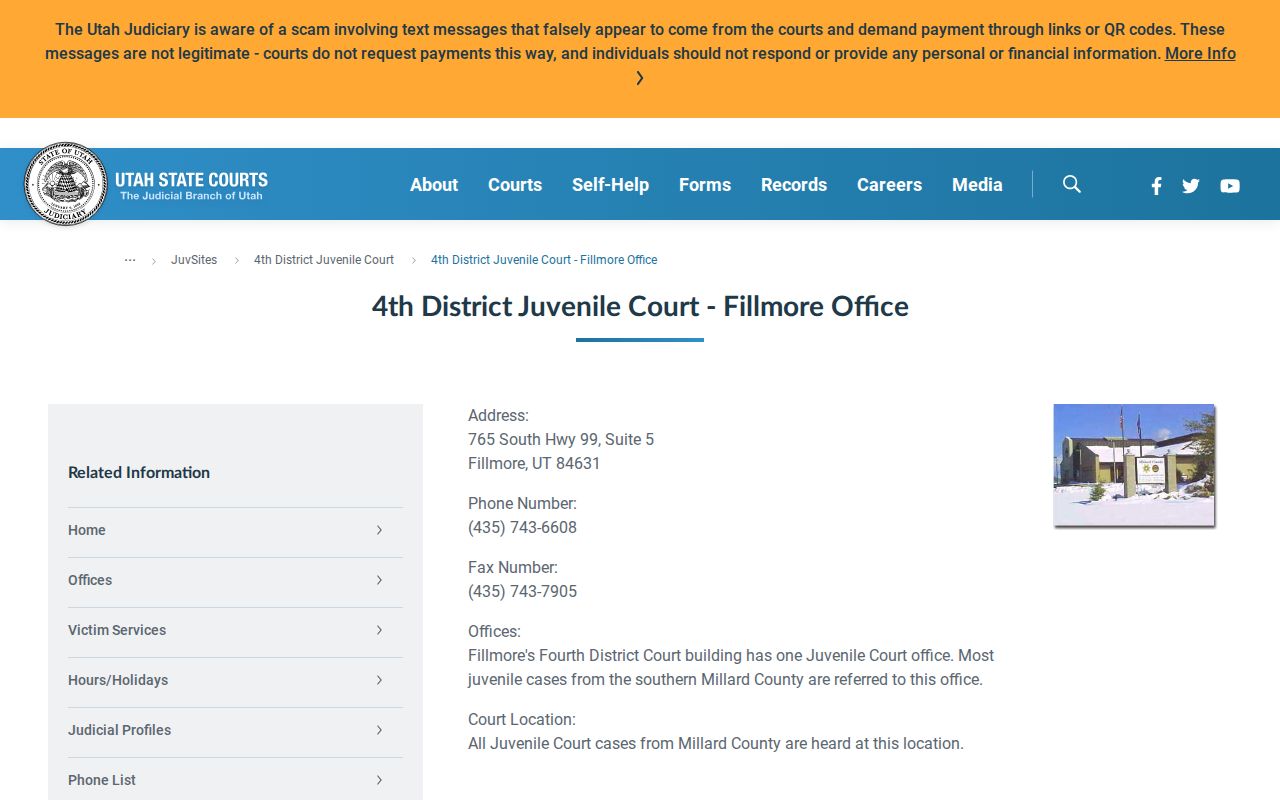
That page supports office routing only. It does not grant public access to a child's case. Anyone seeking a juvenile record must show the permitted role, authorization, or court order that Utah rules require.
Fillmore Court Record Access Rules
Utah courts classify Fillmore case history and set access by rule. Much of the public court docket stays open. Hearings, judgments, orders, decrees, and many filings can be viewed by anyone. Sealed, private, protected, expunged, juvenile, and adoption records are different. Those need a lawful basis. Only then will the clerk release them.
Key Fillmore access rules.
Rule 4-202.02 defines public and nonpublic court record classes.
Rule 4-202.04 governs written requests and proof of entitlement.
Use Xchange, a public terminal, the correct Fillmore clerk counter, phone routing, or the written court-record form. MyCourtCase serves parties and authorized users only. Never seek another person's account credentials.
Fillmore District Clerk Records
The Suite 6 Fillmore office handles district-court records. That covers felonies, class A misdemeanors, general civil cases, probate, domestic cases, district appeals, and district audio requests. Marki Rowley is the listed clerk/manager contact. A Fillmore district request should give the case number, parties, document title, and approximate filing date. That gives staff enough detail to locate the file.
Inspection, a plain copy, an Xchange image, and a certified copy are four different products. Tell the Fillmore clerk which one you need. Phone routing can confirm availability and give an estimate. But formal production may require the written Utah request form. The state says a response usually comes within ten business days. That is subject to access review and the scope of the Fillmore request.
Older Fillmore Court Docket Coverage
Fillmore District Court's listed Xchange connection date is March 2, 1998. Public electronic district documents filed since July 1, 2010 may be available for purchase. Older Fillmore histories or papers can be less complete online. Justice-court conversion dates also vary. A blank Fillmore docket search may reflect coverage gaps, spelling, wrong court level, delayed entry, or a nonpublic classification. It does not always mean an empty file.
For historical Fillmore research, keep notes on the court name, filed names, year, case number, and each source already checked. Search both the proper jurisdiction and the Fillmore location. Then take the question to the Suite 6 or Suite 2 clerk. Which one depends on case type. The original territorial statehouse is part of Fillmore civic history. But a historic setting does not identify the modern record keeper or prove where a Fillmore case sits today.
A useful Fillmore request names one court and one record set. Say whether you want inspection, a plain copy, or certification. Give a date span and document title when known. Staff may need to retrieve, review, redact, or scan the Fillmore material. Public status does not always mean free production. For a hearing recording, use the Fourth District audio request route. Identify the Fillmore courtroom, hearing date, judge, and case number. For a Justice Court file, start at Suite 2. For juvenile material, start at Suite 5 and expect an entitlement review. These routes keep older Fillmore research tied to the office that actually maintains the record.
Fillmore Docket Search Confirmation
Hold onto the Fillmore case number, the court name, the suite, the search date, and how you made the request. That bundle answers most follow-up questions. If Fillmore staff need more, narrow the date span. Or name the exact document rather than firing off another broad request. A public terminal can settle a quick history question. But no screen at the terminal becomes a certified copy on its own.
Before you drive over, recheck Fillmore counter access. Do this mainly after a closure or a service notice. Put the notice beside the calendar and the Xchange history. The clerk in Suite 2, Suite 5, or Suite 6 still has the last word. That word covers the current public setting and the right route for your Fillmore court record.